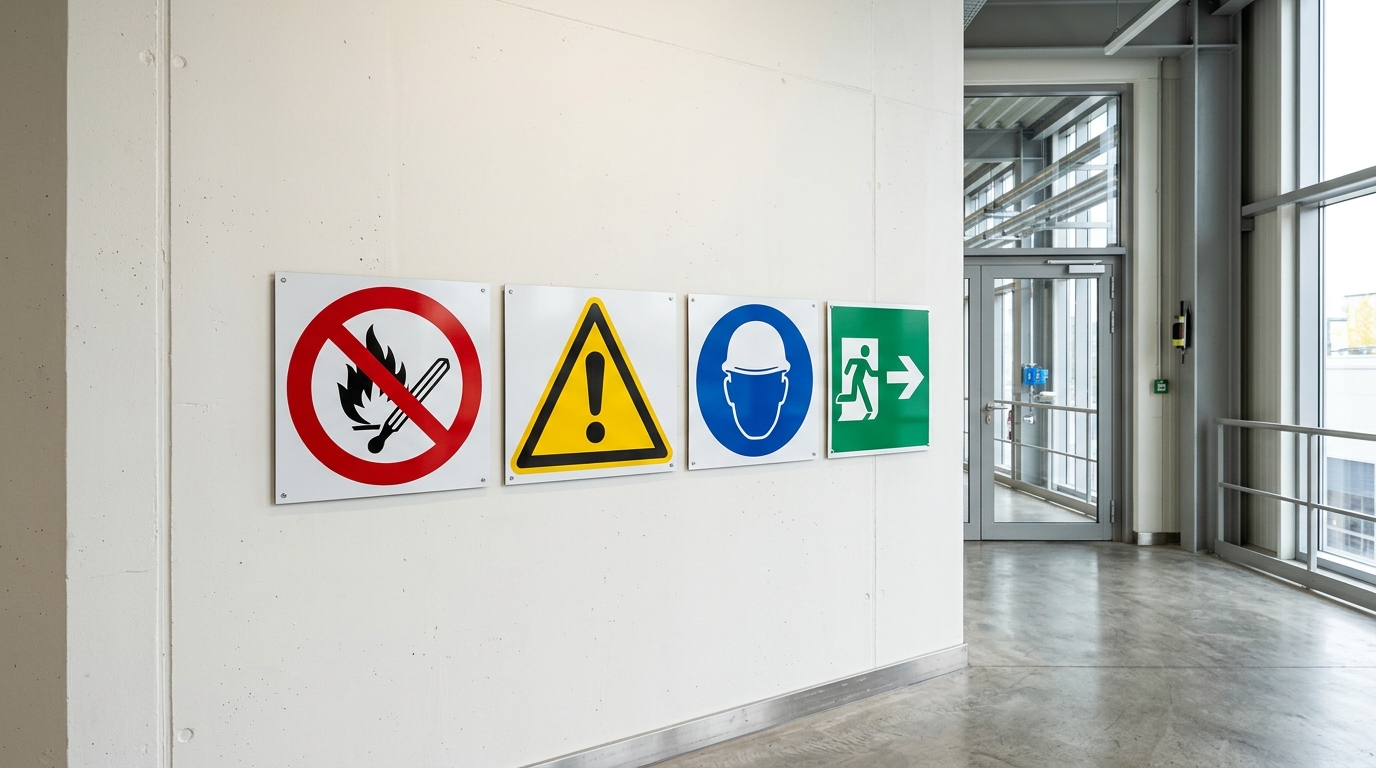
On multinational worksites, written warnings in a single language are not enough to prevent accidents. This is where occupational safety signs and signals under the international ISO 7010 standard come in, relying on a unified visual language of colors and geometric shapes that every worker understands in a split second.
ISO 7010 Safety Sign Colors and Shapes Table
| Color | Geometric Shape | Category | Meaning and Purpose | Common Worksite Examples |
|---|---|---|---|---|
| Red | Circle with red border and diagonal slash | Prohibition Signs | Prohibited behavior that may cause immediate danger | No smoking, No unauthorized entry, No mobile phones |
| Red | Red square or rectangle | Firefighting Equipment (Fire) | Identifies locations of firefighting and alarm equipment | Fire extinguisher, Fire alarm call point, Fire hose reel |
| Yellow | Triangle with black border | Warning Signs | Warning of an existing hazard requiring caution | High voltage hazard, Slippery floor, Flammable materials, Overhead loads |
| Blue | Blue circle with white symbol | Mandatory Signs | Mandatory action or PPE required before entry | Wear hard hat, Wear safety footwear, Wear hearing protection |
| Green | Green square or rectangle | Emergency & Safe Condition Signs | Escape routes and first-aid facilities | Emergency exit, Assembly point, First-aid kit, Emergency eyewash shower |
Detailed Breakdown of Worksite Safety Sign Types
1. Prohibition Signs (Red Color)
Used to stop dangerous actions immediately. They must have a white background with a red circle and a red diagonal slash crossing over the black pictogram.
- Where are they placed? At entrances to electrical transformer rooms, fuel and chemical storage areas, and deep excavation zones.
2. Warning Signs (Yellow Color)
Alert workers to the presence of a hazard source that cannot be completely eliminated. Equilateral triangle with a yellow background and black border.
- Field examples: Warnings for cranes and heavy machinery, toxic gases in confined spaces, or welding radiation.
3. Mandatory Signs (Blue Color)
Enforce the wearing of Personal Protective Equipment (PPE) or compliance with a specific safety procedure as a condition of entering an area.
- Practical example: A blue sign at the project gate indicating that a hard hat, high-visibility vest, and safety shoes are mandatory before crossing the gate.
4. Emergency and Firefighting Signs (Green and Square Red)
- Green signs: Must be illuminated or photoluminescent so they remain visible during a power outage and guide workers to the Assembly Point.
- Square red signs: Point to the nearest fire extinguisher or break-glass fire alarm call point.
Common Mistakes When Installing Safety Signs on Sites
- Clustering dozens of signs together at the gate: This overwhelms workers’ attention and causes them to ignore them.
- Blocking signs with materials or scaffolding: Sign visibility must be checked during daily safety inspections.
- Using faded or non-reflective signs during night shifts: They lose all effectiveness when lighting fails.
Related Articles and Tools in SafetyPro HSE
- Personal Protective Equipment (PPE): Practical Guide to Selection and Inspection
- Fire Extinguisher Types, Colors, and How to Use Them (PASS)
- Workplace Risk Assessment Steps Under ISO 45001
- Browse the Free Word Safety Templates Library