
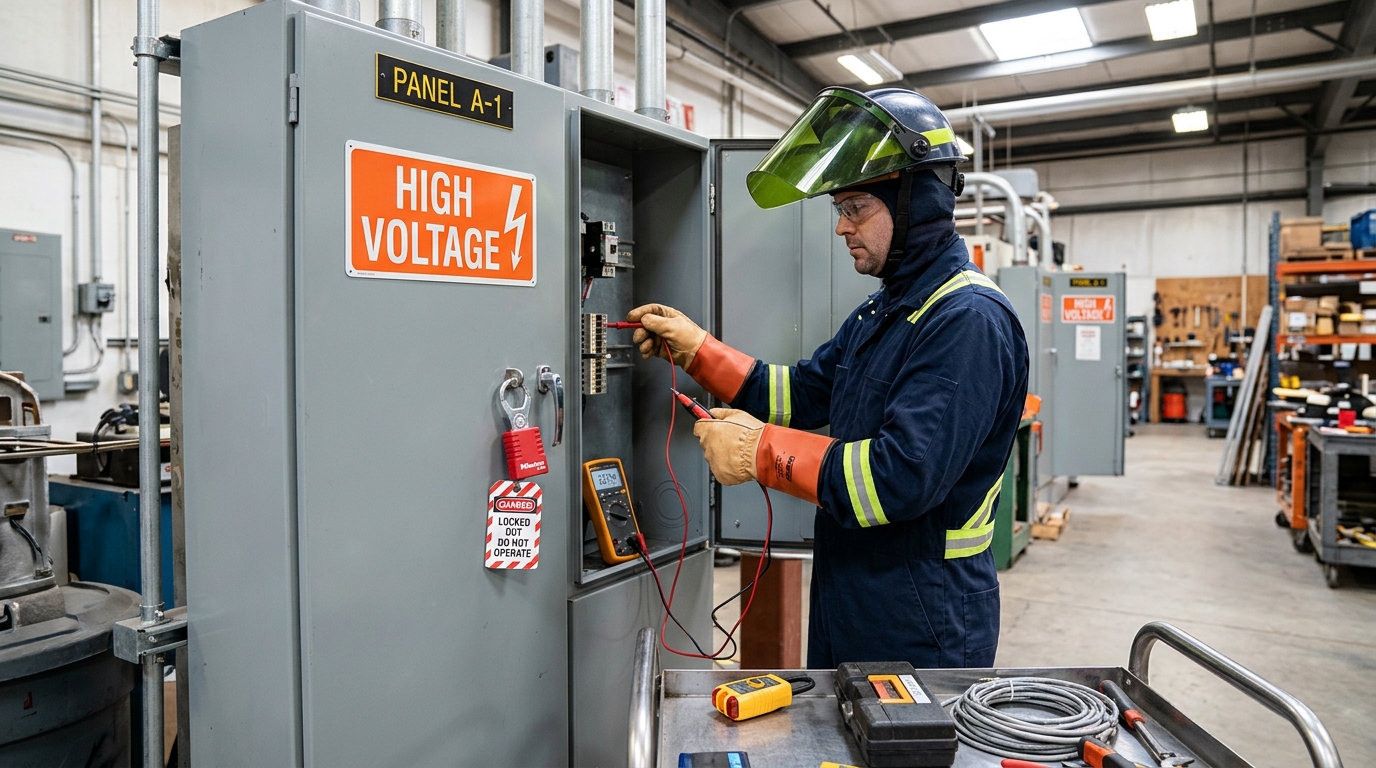
Electrical incidents rank high among the “Focus Four” fatal hazards in the construction industry according to OSHA statistics. The danger of electricity does not lie in high voltage alone—in fact, most field fatalities occur at the familiar 120–240 volts used in temporary power cords, drills, and circular saws when grounding or a Ground Fault Circuit Interrupter (GFCI) is missing.
1. How Electric Current Affects the Human Body (The Real Numbers)
It is not voltage (Volts) alone that kills, but the current (Amperes) passing through the body, its path (especially across the chest/heart), contact duration, and skin resistance (which drops from 100,000 ohms for dry skin to less than 1,000 ohms when sweaty or wet):
| Current (Milliamperes mA) | Physiological Effect on the Body (60Hz AC) |
|---|---|
| 1 mA | Faint tingling sensation, barely perceptible |
| 5 mA | Slight, non-painful shock; this is the trip threshold of a GFCI (4–6 mA) |
| 10 – 20 mA | Involuntary muscle contraction (“let-go” threshold / freezing current) — worker cannot release the wire |
| 50 – 100 mA | Fatal ventricular fibrillation and cessation of blood pumping within seconds |
| 1000+ mA (1 A) | Immediate cardiac arrest and severe internal and external burns |
2. The Four Electrical Hazards on Sites (Practical Application)
A. Electric Shock
Occurs when touching a live conductor and completing the circuit to ground through the worker’s body, most commonly caused by:
- Damaged extension cords or cables run over by carts and heavy equipment without protection.
- Removing the third ground pin from three-prong plugs.
- Using power tools in damp locations without double insulation or a
GFCI.
B. Arc Flash & Arc Blast
When a short circuit occurs between two phases or between a phase and ground inside a distribution panel, the air gap ionizes and temperatures reach 19,000°C (three times hotter than the surface of the sun), accompanied by an explosive pressure wave that throws the worker back and vaporizes copper conductors, causing deep burns even without direct contact.
- Prevention: Comply with approach boundaries under NFPA 70E, and wear arc-rated PPE (
Arc-Rated PPE) classified incal/cm²according to the panel’s arc flash study.
C. Electrical Fires
Result from overloading circuits beyond their capacity, or loose connections inside breakers that locally increase resistance and heat.
D. Contact with Overhead and Buried Lines
A crane boom or dump truck striking an overhead power line, or cutting a buried medium-voltage cable during excavation.
3. Mandatory Controls Under OSHA 1926 Subpart K
- Ground Fault Circuit Interrupters (GFCI – 1926.404):
- A GFCI monitors the difference between incoming and outgoing current; if just
4–6 mAleaks (to ground or through a worker’s body), it trips the circuit in less than 25 milliseconds. - The
Test / Resetbutton must be tested before every shift.
- A GFCI monitors the difference between incoming and outgoing current; if just
- Overhead Power Line Clearances (OSHA 1926.1408):
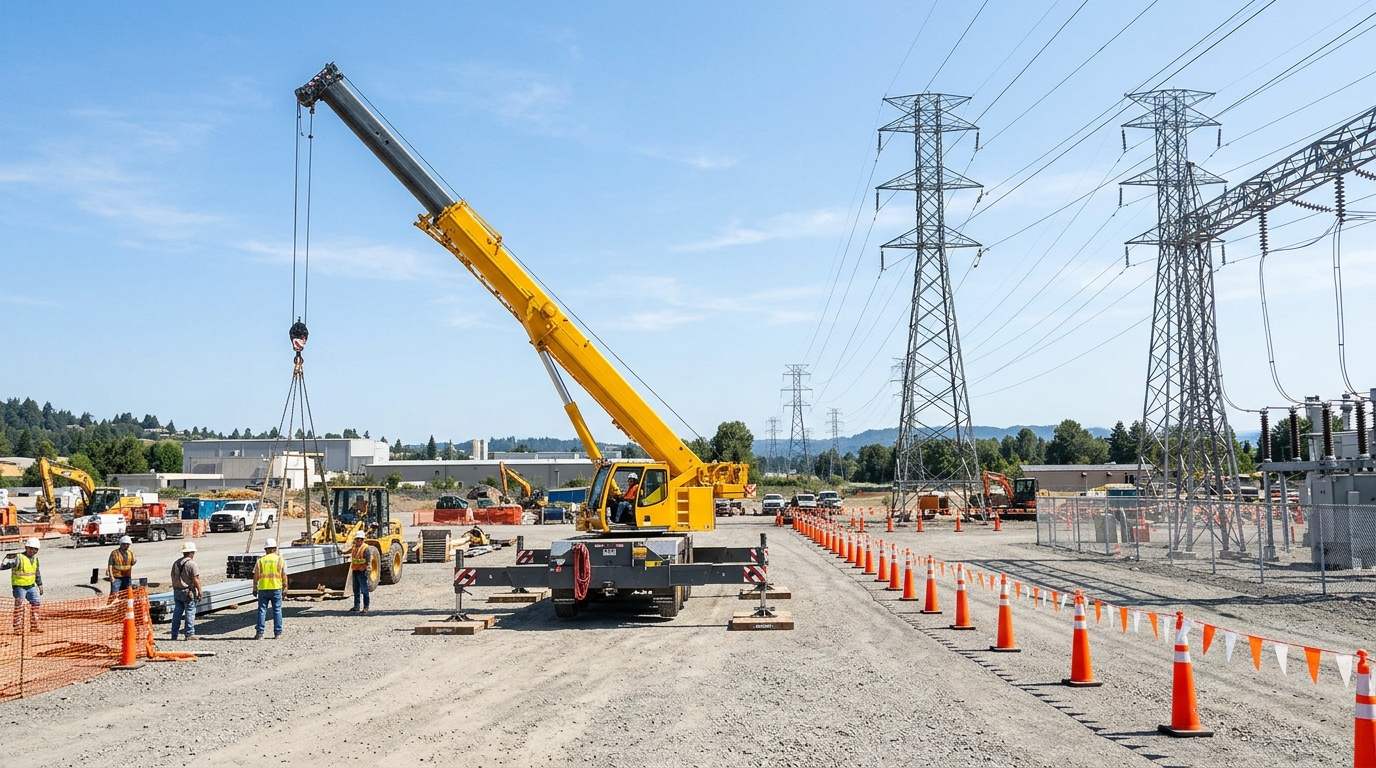
| Power Line Voltage (kV) | Minimum Safe Clearance |
|---|---|
| Up to 50 kV | 3.05 meters (10 feet) |
| 50 – 200 kV | 4.6 meters (15 feet) |
| 200 – 350 kV | 6.1 meters (20 feet) |
| 350 – 500 kV | 7.6 meters (25 feet) |
- Lockout/Tagout (LOTO) & the
Live-Dead-LiveRule:- Never work on any energized circuit without an engineering-justified energized electrical work permit.
- For routine work: isolate, apply a personal lock and identification tag (Lockout/Tagout), discharge stored energy, and perform the
Live-Dead-Livetest using a rated multimeter (CAT III / CAT IV). (For more details, see: Lockout/Tagout (LOTO) Guide and Switchgear and Cable Testing Before Energization).
4. Mistakes a Consultant Will Reject Immediately on Site
- “Spider” splices or ordinary electrical tape on a damaged site power cable (ordinary tape is rejected; the cable must be replaced or repaired with an approved heat-shrink insulated splice).
- Open temporary distribution boards without a Dead Front Cover shielding live busbars.
- Missing monthly color-coding inspection tags on portable power tools and extension cords.
- Laying extension cords directly on wet ground instead of elevating them on insulated
S-Hooksat least 2.4 meters high in walkways.
Related Articles and Tools in SafetyPro HSE
- Lockout/Tagout (LOTO) Energy Isolation and Warning Tags System
- Fire Extinguisher Types: Why Water Extinguishers Are Prohibited on Electricity
- 5×5 Risk Assessment Matrix Calculator
- Download Ready-to-Use Field Safety Word Templates